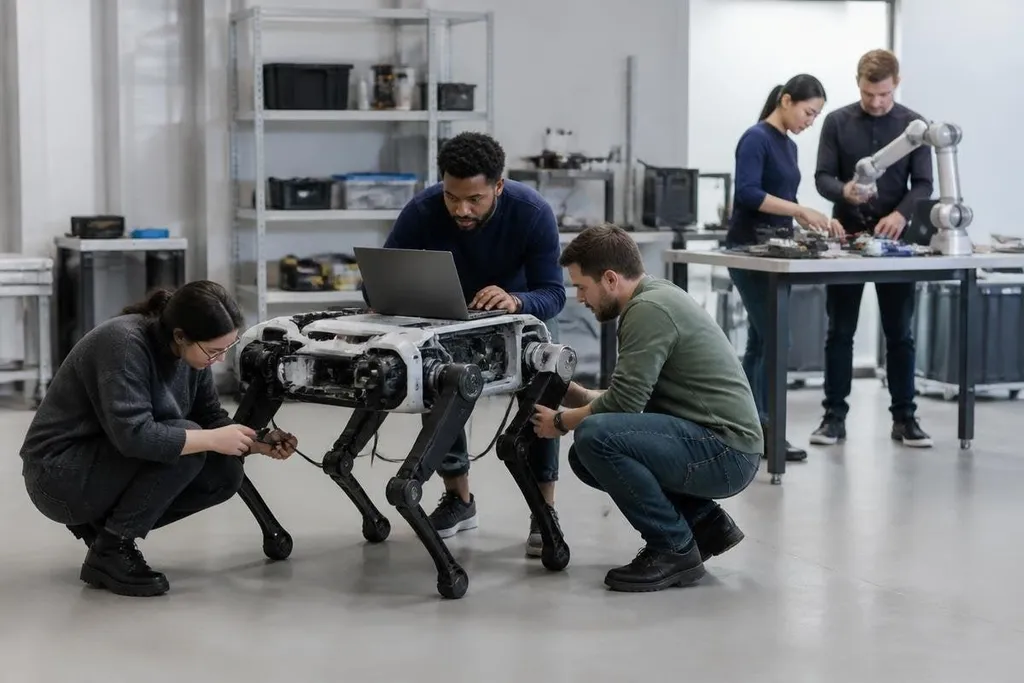
A robot needs more than a clever model or a strong motor. It needs people who can design parts, write control code, test sensors, repair faults, and make the system safe to run.
For someone choosing a career, the best robotics job depends on the work you want each day: software, hardware, field work, research, or product decisions.
Quick read
- Controls engineers turn motion plans into safe movement.
- Mechanical engineers build the body, joints, tools, and mounts.
- Field engineers make robots work outside the lab, where floors, cables, and people rarely behave as planned.
Controls and software jobs
A controls engineer decides how a robot moves. They work with motors, encoders, force sensors, and control loops. A control loop checks the robot’s position, compares it with the target, and adjusts the motor command.
That work matters because a robot can have strong hardware and still move badly. Poor tuning can cause vibration, slow motion, missed positions, or a motor stall.
Controls engineers often work with simulation before testing on a real robot, which cuts the risk of breaking costly parts.
Robotics software engineers connect the pieces. They may write code for planning, perception, hardware interfaces, or fleet tools. Python is common for testing and data work, while C++ is widely used when a system needs fast, steady control.
A software role can also focus on perception. The engineer uses cameras, LiDAR, or other sensors to help the robot find objects and measure its position. The hard part is making that system work when lighting changes, an object moves, or part of the scene is blocked.
Mechanical and electrical jobs
Mechanical engineers build the physical system. Their work covers frames, gearboxes, joints, wheels, grippers, cable paths, and service access. A design that looks good in computer-aided design software still needs to survive loads, heat, dust, and repeated motion.
Electrical engineers choose motors, batteries, circuit boards, power supplies, and wiring. They also check heat, current, signal noise, and safety shutoffs. A small wiring fault can stop a full robot, so this work reaches far beyond drawing a circuit diagram.
Robotics needs technicians, too. A technician assembles machines, checks wiring, replaces parts, and helps engineers find faults. This path suits someone who prefers tools and measured tests to long hours at a screen.
The work can change from one day to the next. A technician might check a motor in the morning, then trace a sensor fault through a control cabinet after lunch.
Jobs that connect robots to real sites
Field engineers install robots at customer sites and fix problems after deployment. They may adjust sensor positions, change software settings, check network links, and train the people who operate the system.
This role needs patience because the site sets the rules. A warehouse can have uneven floors, narrow paths, changing stock, and workers moving through the robot’s route. A lab test rarely covers all of that.
Safety engineers review hazards and help teams meet rules for robot operation. They study pinch points, stopping distance, access limits, emergency stops, and the space around moving equipment. Their work can affect the robot’s speed, layout, and daily operating procedure.
Product managers and operations staff turn customer needs into robot tasks that engineers can build and test. They set the measures that show whether the system works, then decide which faults need a human response. A product manager can use Robot24.com to track changes in robot deployments and test results, while those choices give research teams clear questions about data, performance, and failure.
Research and data work
Research engineers test ideas that may later reach a product. They might study walking robots, grasping, motion planning, machine learning, or human-robot interaction. The work often starts with a narrow test, then grows only when the results hold up.
Data engineers and robotics analysts prepare the records that help teams find failures. They label sensor data, check logs, compare test runs, and build tools for reviewing robot behavior. Good data work can show why a robot misses a part at one angle but succeeds at another.
A research role suits someone who can live with an unanswered question for a while. Product work moves toward a shipment; research may spend months testing one small change.
A practical way to choose
Use this checklist before applying for a course or job:
- Pick your work surface: laptop, workbench, test floor, or customer site.
- Learn one useful stack: Python, C++, ROS 2, CAD, PLCs, or sensor tools.
- Build one working project: show the code, wiring, test method, and result.
- Check the daily task: read job posts for verbs such as test, repair, tune, model, or install.
- Ask about site work: travel, shift patterns, safety training, and after-hours support can change the role.
I'd choose field engineering for someone who wants to see a robot earn its place in a real workplace. It brings software, hardware, safety, and human needs into the same shift.
The strongest first step is a small project with a clear result: a robot that moves, senses, or picks something, plus a record of what failed and how you fixed it.